

The difference between a mediocre AI response and an exceptional one isn't luck—it's how you frame your question. Studies show that well-structured prompts improve output quality by up to 47%, yet most people waste hours getting generic results because they never learned how to write prompts for Gemini effectively.
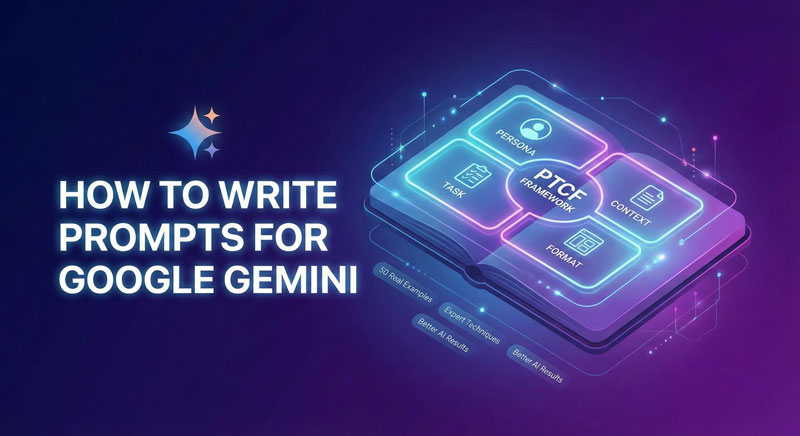
Google's research team developed the PTCF framework (Persona, Task, Context, Format). This structured approach transforms vague requests into precision-engineered prompts that consistently deliver professional-grade outputs. Whether you're a marketer, developer, or content creator, mastering this framework will revolutionize how you work with AI.
In this comprehensive Google Gemini prompting guide, you'll learn the exact methodology Google recommends, advanced techniques like chain-of-thought prompting, 50 ready-to-use templates, and the common mistakes that sabotage most users' results.
What Is the PTCF Framework for Gemini Prompts?
The PTCF framework structures prompts into four components: (1) Persona—the role Gemini should adopt, (2) Task—your specific request, (3) Context—relevant background information, and (4) Format—how the output should be structured. This Google-recommended method ensures clarity, reduces ambiguity, and significantly improves response quality compared to vague prompts.
Understanding the PTCF Framework
The PTCF framework isn't just a suggestion—it's the foundation of effective Gemini prompt engineering. Each component serves a specific purpose in guiding the AI toward your desired outcome.
Persona: Who Should Your AI Become?
The persona defines the role, expertise level, and perspective Gemini adopts. Think of it as casting an actor for a specific role—the more precisely you define the character, the better the performance.
Why it matters: A persona sets the knowledge depth, communication style, and professional vocabulary. An "SEO strategist" writes differently than a "friendly writing coach."
- "Act as an expert SEO strategist with 15 years of experience ranking enterprise websites."
- "You are a friendly fitness coach explaining concepts to complete beginners."
- "Assume the role of a legal compliance analyst specializing in GDPR regulations."
Task: What Exactly Do You Want Done?
The task component is where precision pays the highest dividends. Vague tasks produce vague results. Specific tasks produce actionable outputs. Be explicit about the action, scope, and deliverable.
Weak Task |
Strong Task |
|---|---|
Write about marketing |
Write a 500-word blog post outlining 5 email marketing strategies for SaaS companies |
Help me with code |
Debug this Python function and explain each fix with inline comments |
Create a report |
Create a 2-page market analysis report on EV adoption in Europe with 3 competitor profiles |
Context: What Background Information Helps?
Context is where Gemini's 1-million-token context window becomes your competitive advantage. Unlike other models, Gemini can process entire codebases, comprehensive documents, and multi-file projects simultaneously.
- Audience information: "I'm writing for busy CTOs who need quick, actionable insights."
- Domain-specific details: "Our industry uses 'churn' to mean monthly subscription cancellations."
- Constraints: "Budget is under $5,000 and timeline is 2 weeks."
- References: "Here's our competitor's landing page [URL] and our current version [PDF]."
Format: How Should the Output Be Structured?
Format specifications transform raw AI output into immediately usable deliverables. Without format guidance, you'll spend time reformatting. With it, you get plug-and-play results.
- Structure: Bullet points, numbered steps, tables, paragraphs, JSON
- Length: Word count, number of items, page limits
- Tone: Formal, conversational, technical, persuasive
- Sections: Required headers, order of information
Complete PTCF Framework Example
Persona Act as an experienced content marketing strategist who has helped B2B SaaS companies grow organic traffic.
Task Create a 90-day content calendar with 12 blog post topics optimized for search traffic.
Context Our company sells project management software to mid-size agencies (50-200 employees). Competitors rank well for 'agency project management' and 'client collaboration tools.' Our differentiator is built-in time tracking.
Format Present as a table with columns: Week, Topic, Primary Keyword, Search Intent, Content Angle. Include a brief rationale paragraph after the table.
Why this works: The persona establishes expertise. The task specifies exact deliverables. Context provides competitive intelligence. Format ensures immediately actionable output.
Core Prompting Principles Google Recommends
Beyond the PTCF framework, Google's Gemini prompt engineering best practices include five additional principles that separate amateur prompts from professional ones.
1. Be Precise and Direct
Vague language is the enemy of quality output. Replace qualitative terms with quantitative specifications:
- Instead of "short article," specify "800-word article"
- Instead of "recent data," specify "data from 2023-2024"
- Instead of "improve this," specify "increase clarity for non-technical readers"
2. Use Consistent Structure with Clear Delimiters
Google recommends XML-style tags for complex prompts. This helps Gemini parse different components and reduces misinterpretation.
3. Define All Parameters Explicitly
Never assume Gemini understands your jargon. Define ambiguous terms and clarify audience expertise levels. Example: "By 'beginner-friendly,' I mean accessible to someone with no programming background."
4. Provide Abundant Context
With Gemini's massive context window, more information almost always produces better results. Include relevant documents, reference URLs, and explicit constraints. Put your query at the end after providing all context.
5. Break Down Complex Tasks
Use prompt chaining instead of cramming everything into one massive prompt. Each focused prompt produces higher quality than one overloaded request.
Advanced Techniques for Expert-Level Results
These advanced Gemini prompt optimization techniques unlock professional-grade outputs that few users achieve.
Few-Shot vs. Zero-Shot Prompting
Zero-shot prompting provides instructions without examples. Few-shot prompting includes 2-5 examples of desired input-output pairs. Research shows few-shot prompts are significantly more effective for complex tasks.
When to use few-shot:
- Tasks requiring specific output formatting
- Creative work needing consistent style or voice
- Technical tasks with precise syntax requirements
- Classification or categorization tasks
Chain-of-Thought Prompting
Chain-of-thought (CoT) prompting asks Gemini to show its reasoning step by step. This technique improves factual accuracy by 30%+ for complex reasoning tasks.
- Ask Gemini to outline its reasoning approach first
- Request explicit assumptions and intermediate conclusions
- Have it critique its own draft before finalizing
Trigger phrase: "Think through this step by step. First, identify the key variables. Then, analyze their relationships. Finally, provide your conclusion with confidence level."
Prompt Chaining for Complex Workflows
Prompt chaining uses the output of one prompt as input for the next. Essential for tasks that exceed single-prompt capabilities.
- Prompt A: "Research competitors and identify content gaps" → Gap analysis
- Prompt B: "Create detailed outline based on gap analysis" → Outline
- Prompt C: "Write introduction section following outline" → Draft intro
- Prompt D: "Optimize draft for SEO with target keywords" → Final content
Iterative Refinement Process
First prompts are rarely perfect. Research indicates optimal prompts average around 21 words—longer than most users' initial attempts.
- Start with a clear, simple prompt
- Evaluate output against specific quality criteria
- Identify the specific gap (too long? wrong tone? missing detail?)
- Adjust one element at a time
- Test again and lock in improvements
Common Mistakes to Avoid
Recognizing these pitfalls will immediately improve your Gemini prompt effectiveness.
Vague or Ambiguous Instructions
The problem: "Write an article about sustainability" leaves Gemini guessing about length, audience, angle, and format.
The fix: "Write a 1,200-word SEO-optimized blog post about sustainable fashion for women aged 25-35 who value ethical consumption. Include 3 actionable tips and 2 brand recommendations."
Missing or Unclear Constraints
Failing to specify length, tone, format, audience, or technical level leads to outputs that miss the mark. Make every requirement explicit.
Overly Complex Nested Instructions
Conditional logic with more than 2-3 levels of nesting confuses even advanced models. If your prompt reads like code, break it into separate prompts.
Insufficient Context
Not providing background information handicaps Gemini's ability to deliver relevant results. With a 1-million-token context window, there's rarely an excuse for under-informing the model.
Ignoring Multimodal Opportunities
Gemini excels with images, documents, and URLs—yet most users stick to text-only prompts. Upload competitor screenshots, attach reference PDFs, and provide URLs for comprehensive context.

Rebranding Brand Colors in 2026? 7 Critical Steps Before You Change
Planning a visual rebrand? Discover the essential steps to ensure your new color palette resonates with your audience and strengthens your brand identity.
50 Real-World Gemini Prompt Examples by Use Case
These Gemini prompt templates are ready for immediate use. Copy, customize, and deploy for your specific needs.
Content Creation Prompts (1-10)
Blog Post Generator
[Persona] Act as an experienced content marketer specializing in B2B technology with 10+ years creating high-ranking content. [Task] Write a 1,500-word blog post on the topic: [TOPIC]. [Context] Target audience: IT decision-makers at mid-size companies (100-500 employees). Competitors ranking for [KEYWORD]. Our brand voice is professional but approachable. [Format] Include: attention-grabbing intro with statistic, 5 H2 subheadings, actionable conclusion with CTA, meta description under 160 characters.
Social Media Series Creator
[Persona] Social media strategist for lifestyle brands with expertise in engagement optimization. [Task] Create 10 LinkedIn posts promoting [PRODUCT/SERVICE] over a 2-week campaign. [Context] Audience: professionals aged 30-50 interested in productivity and career growth. Brand voice: authoritative yet approachable. Goal: drive traffic to landing page. [Format] Each post: hook (first line), value point, CTA. Vary formats across: question posts, statistic posts, story posts, how-to posts, and opinion posts.
Email Welcome Sequence
[Persona] Email marketing specialist with 10+ years DTC experience and proven conversion optimization skills. [Task] Write a 5-email welcome sequence for new newsletter subscribers. [Context] Brand: [DESCRIPTION]. Products: [LIST]. Average customer: [PROFILE]. Goal: introduce brand values, build trust, drive first purchase within 14 days. [Format] Each email includes: subject line (under 50 chars), preview text (under 90 chars), body copy (150-200 words), single CTA button with text. Space emails: Day 0, Day 2, Day 5, Day 8, Day 12.
Newsletter Draft
[Persona] Newsletter editor for a [INDUSTRY] publication with a talent for curating valuable insights. [Task] Write this week's newsletter covering [TOPICS/THEMES]. [Context] Subscriber base: [SIZE] professionals in [FIELD]. Newsletter style: informative, scannable, with personality. Previous open rate: [X]%. [Format] Structure: catchy subject line, personal intro (50 words), 3 main stories with summaries (100 words each), 2 quick links, closing thought, P.S. line with CTA.
Product Description Writer
[Persona] E-commerce copywriter specializing in conversion-focused product descriptions for premium brands. [Task] Write compelling product descriptions for these [NUMBER] products: [LIST]. [Context] Brand positioning: [PREMIUM/BUDGET/MID-RANGE]. Target customer: [PROFILE]. Key differentiators from competitors: [LIST]. [Format] Each description: headline (under 10 words), benefit-focused opening (25 words), 3 bullet points highlighting features-as-benefits, closing line with subtle urgency. Total length: 100-150 words per product.
Case Study Outline
[Persona] B2B content strategist who creates case studies that drive enterprise sales conversations. [Task] Create a detailed case study outline for [CLIENT NAME]'s success with our [PRODUCT/SERVICE]. [Context] Client industry: [INDUSTRY]. Challenge they faced: [PROBLEM]. Results achieved: [METRICS]. Sales team will use this for [USE CASE]. [Format] Sections: Executive Summary (50 words), Challenge (150 words), Solution (200 words), Implementation (150 words), Results with specific metrics (200 words), Client Quote placeholder, Next Steps CTA.
Press Release Draft
[Persona] PR professional with experience writing press releases that get picked up by major publications. [Task] Write a press release announcing [NEWS/LAUNCH/MILESTONE]. [Context] Company: [NAME] in [INDUSTRY]. News significance: [WHY IT MATTERS]. Target publications: [LIST]. Spokesperson: [NAME, TITLE]. [Format] Follow AP style. Include: attention-grabbing headline, city/date line, strong lead paragraph with who/what/when/where/why, 2-3 supporting paragraphs, executive quote, boilerplate paragraph, media contact information. Total: 400-500 words.
Landing Page Copy
[Persona] Conversion copywriter who has written landing pages generating millions in revenue. [Task] Write complete landing page copy for [PRODUCT/SERVICE/OFFER]. [Context] Traffic source: [PAID ADS/ORGANIC/EMAIL]. Visitor awareness level: [PROBLEM-AWARE/SOLUTION-AWARE]. Main objections: [LIST]. Conversion goal: [SIGN UP/PURCHASE/DEMO]. [Format] Sections: Hero (headline, subhead, CTA), Problem agitation, Solution introduction, Benefits (not features), Social proof section, FAQ objection handlers, Final CTA with urgency.
Video Script Writer
[Persona] Video content strategist who creates scripts for high-retention YouTube and social videos. [Task] Write a script for a [LENGTH]-minute video about [TOPIC]. [Context] Platform: [YOUTUBE/TIKTOK/INSTAGRAM]. Audience: [DESCRIPTION]. Video style: [EDUCATIONAL/ENTERTAINING/PROMOTIONAL]. Speaker on camera: [YES/NO]. [Format] Include: hook (first 5 seconds), pattern interrupt at 30 seconds, main content with visual cues in brackets, B-roll suggestions, end screen CTA. Add timestamps and estimated word count per section.
Podcast Show Notes
[Persona] Podcast producer who creates show notes that drive downloads and listener engagement. [Task] Create comprehensive show notes for Episode [NUMBER]: [TITLE] featuring [GUEST]. [Context] Podcast topic: [NICHE]. Episode length: [DURATION]. Key discussion points: [LIST]. Guest bio: [BRIEF]. [Format] Include: SEO-optimized episode title, 150-word summary, timestamp breakdown of key moments, 5 key takeaways as bullets, guest links and resources, related episode links, CTA to subscribe/review.
SEO & Marketing Prompts (11-20)
Keyword Research Strategy
[Persona] Senior SEO strategist with enterprise client experience and deep keyword research expertise. [Task] Analyze this seed keyword list and create a comprehensive content cluster strategy: [KEYWORDS]. [Context] Domain: [URL]. Industry: [INDUSTRY]. Current DA: [SCORE]. Main competitors: [LIST]. Business goals: [CONVERSIONS/TRAFFIC/AUTHORITY]. [Format] Deliver as table with columns: Keyword, Monthly Volume Estimate, Search Intent (informational/commercial/transactional), Difficulty Estimate (low/medium/high), Recommended Content Type, Pillar or Cluster designation, Internal Linking Target.
Competitor Content Analysis
[Persona] Competitive intelligence analyst specializing in content gap identification. [Task] Analyze these competitor URLs and identify content opportunities: [URLS]. [Context] Our domain: [URL]. Our current content focus: [TOPICS]. Target keywords we want to rank for: [LIST]. [Format] Provide: SWOT analysis of competitor content, list of 10 content gaps we can exploit, recommended content types for each gap, priority ranking based on potential traffic impact, estimated effort level for each opportunity.
Meta Description Batch Writer
[Persona] SEO copywriter who crafts meta descriptions with high click-through rates. [Task] Write unique, compelling meta descriptions for these [NUMBER] pages: [LIST WITH TITLES AND URLS]. [Context] Brand voice: [DESCRIPTION]. Target keywords for each page: [LIST]. Competitor meta descriptions to differentiate from: [EXAMPLES]. [Format] Each meta description: 150-160 characters exactly, includes primary keyword naturally, features benefit or curiosity hook, ends with subtle CTA or value proposition. Provide character count for each.
Title Tag Optimizer
[Persona] SEO specialist focused on improving organic click-through rates through title optimization. [Task] Optimize these [NUMBER] title tags for better rankings and CTR: [CURRENT TITLES]. [Context] Target keywords: [LIST]. Current rankings: [POSITIONS]. Competitor titles in SERP: [EXAMPLES]. Brand name inclusion: [YES/NO/OPTIONAL]. [Format] For each title provide: original title, optimized version (under 60 characters), character count, primary keyword placement, power word used, expected CTR improvement rationale.
Internal Linking Audit
[Persona] Technical SEO consultant specializing in site architecture and internal linking strategies. [Task] Audit our internal linking structure and provide optimization recommendations for these pages: [URLS]. [Context] Site structure: [DESCRIPTION]. Priority pages for rankings: [LIST]. Current internal link distribution: [OVERVIEW]. [Format] Deliver: current internal link count per page, recommended link additions with anchor text suggestions, orphaned pages identified, hub page recommendations, priority action items ranked by impact.
Content Refresh Recommendations
[Persona] Content strategist specializing in updating existing content for improved rankings and relevance. [Task] Analyze this underperforming content and provide refresh recommendations: [URL OR CONTENT]. [Context] Original publish date: [DATE]. Current ranking: [POSITION] for [KEYWORD]. Target ranking: [GOAL]. Competitor content ranking above us: [URLS]. [Format] Provide: content freshness issues, missing topics competitors cover, outdated statistics to update, new sections to add, sections to remove or consolidate, updated word count target, revised title and meta description.
SERP Feature Targeting
[Persona] SEO strategist with expertise in featured snippet and rich result optimization. [Task] Optimize this content to capture SERP features for [KEYWORD]: [CONTENT OR URL]. [Context] Current SERP features present: [LIST]. Competitor holding featured snippet: [URL]. Question-based searches in this topic: [LIST]. [Format] Provide: featured snippet optimization (paragraph, list, or table format), FAQ schema recommendations with Q&A pairs, How-To schema structure, People Also Ask questions to target, content restructuring recommendations.
Local SEO Strategy
[Persona] Local SEO expert who helps businesses dominate local search results and Google Maps. [Task] Create a comprehensive local SEO strategy for [BUSINESS NAME]. [Context] Business type: [CATEGORY]. Service areas: [LOCATIONS]. Current Google Business Profile status: [DETAILS]. Local competitors: [LIST]. Reviews: [COUNT AND AVERAGE]. [Format] Deliver: GBP optimization checklist, local keyword targets by location, citation building priorities, review generation strategy, local content recommendations, local link building opportunities.
Link Building Outreach Templates
[Persona] Link building specialist with high response rates and relationship-focused outreach approach. [Task] Create [NUMBER] personalized outreach email templates for acquiring backlinks to [URL/CONTENT]. [Context] Link building tactic: [GUEST POST/RESOURCE PAGE/BROKEN LINK/SKYSCRAPER]. Target sites: [NICHE/TYPE]. Our unique value proposition: [WHAT WE OFFER]. [Format] Each template includes: subject line (under 50 chars), personalized opening, value proposition, specific ask, easy next step, professional signature. Provide A/B variations for each.
Marketing Funnel Analysis
[Persona] Growth marketing strategist who optimizes full-funnel customer journeys. [Task] Analyze our marketing funnel and identify optimization opportunities: [FUNNEL DATA]. [Context] Funnel stages: [AWARENESS → CONSIDERATION → DECISION → RETENTION]. Current conversion rates by stage: [DATA]. Traffic sources: [BREAKDOWN]. Customer acquisition cost: [CAC]. [Format] Provide: stage-by-stage conversion analysis, drop-off point identification, 3 quick wins per stage, content gaps in the funnel, recommended A/B tests, projected impact of improvements.
Data Analysis Prompts (21-30)
Dataset Interpretation
[Persona] Senior data analyst with business consulting background who translates data into executive insights. [Task] Analyze this dataset and identify the top insights relevant to [BUSINESS GOAL]: [DATA OR FILE]. [Context] Data represents: [DESCRIPTION]. Time period: [DATES]. Key metrics we care about: [LIST]. Decisions this will inform: [CONTEXT]. [Format] Deliver: executive summary (100 words), 5 ranked insights with supporting data points, visualization recommendations for each insight, recommended actions with expected impact, data quality notes or caveats.
Survey Results Synthesizer
[Persona] Market research analyst specializing in translating customer feedback into product decisions. [Task] Synthesize these survey responses into actionable recommendations: [DATA]. [Context] Survey goal: [PURPOSE]. Respondent profile: [DEMOGRAPHICS]. Sample size: [NUMBER]. Margin of error: [IF KNOWN]. [Format] Provide: key themes with response frequency, sentiment analysis by theme, statistical significance notes, prioritized recommendations with confidence levels, surprising findings highlighted, suggested follow-up research questions.
Financial Report Summary
[Persona] Financial analyst who creates clear, actionable summaries for executive decision-making. [Task] Summarize this financial report for the leadership team: [REPORT DATA]. [Context] Reporting period: [TIMEFRAME]. Comparison period: [PREVIOUS]. Key stakeholders: [AUDIENCE]. Strategic priorities: [GOALS]. [Format] Include: 3-sentence executive summary, key metrics with YoY/QoQ changes, revenue and expense highlights, cash flow status, risk indicators, recommended actions, 3 questions leadership should discuss.
A/B Test Interpreter
[Persona] Experimentation specialist who helps teams make confident decisions from test results. [Task] Interpret these A/B test results and recommend next steps: [TEST DATA]. [Context] Test hypothesis: [STATEMENT]. Primary metric: [METRIC]. Secondary metrics: [LIST]. Test duration: [DAYS]. Traffic split: [PERCENTAGE]. [Format] Deliver: statistical significance assessment, practical significance evaluation, segment analysis if applicable, confidence level in results, clear recommendation (ship/iterate/kill), suggested follow-up tests, learnings documentation.
Customer Segmentation Analysis
[Persona] Customer analytics expert who identifies high-value segments for targeted marketing. [Task] Analyze this customer data and create actionable segments: [DATA]. [Context] Business model: [B2B/B2C/SUBSCRIPTION]. Current segmentation: [IF ANY]. Marketing goals: [ACQUISITION/RETENTION/UPSELL]. Available personalization channels: [LIST]. [Format] Provide: 4-6 distinct segments with names, segment size and value metrics, behavioral characteristics of each, recommended messaging by segment, channel preferences by segment, quick-win campaign ideas per segment.
Trend Analysis Report
[Persona] Business intelligence analyst who identifies meaningful patterns in time-series data. [Task] Analyze trends in this data and forecast future performance: [DATA]. [Context] Metric being tracked: [NAME]. Historical period: [TIMEFRAME]. Known seasonality: [PATTERNS]. External factors to consider: [EVENTS/CHANGES]. [Format] Include: trend direction and strength, seasonality patterns identified, anomalies flagged with potential explanations, 3-6 month forecast with confidence intervals, leading indicators to monitor, recommended actions based on trajectory.
KPI Dashboard Narrative
[Persona] Data storyteller who transforms dashboard metrics into compelling executive narratives. [Task] Write the narrative summary for this month's KPI dashboard: [METRICS DATA]. [Context] Company goals: [OKRs OR TARGETS]. Previous period performance: [COMPARISON]. Key initiatives this period: [LIST]. Audience: [EXECUTIVES/BOARD/TEAM]. [Format] Structure: headline finding (1 sentence), performance summary (3 sentences), wins to celebrate, areas of concern, actions underway, outlook for next period. Use specific numbers throughout.
Anomaly Detection Explainer
[Persona] Data analyst who investigates and explains unusual patterns to non-technical stakeholders. [Task] Investigate and explain this data anomaly: [ANOMALY DESCRIPTION AND DATA]. [Context] Normal baseline: [EXPECTED VALUES]. When anomaly occurred: [DATE/TIME]. Potential contributing factors: [KNOWN EVENTS]. Impact on business: [DESCRIPTION]. [Format] Deliver: anomaly characterization (what happened), root cause hypothesis with supporting evidence, alternative explanations considered, business impact quantification, recommended response, monitoring adjustments needed.
Cohort Analysis Report
[Persona] Growth analyst specializing in cohort-based retention and lifetime value analysis. [Task] Perform cohort analysis on this user data and identify retention patterns: [DATA]. [Context] Cohort definition: [SIGN-UP DATE/FIRST PURCHASE/ETC]. Time periods: [WEEKLY/MONTHLY]. Key events tracked: [ACTIONS]. Product changes during period: [IF ANY]. [Format] Include: cohort retention table, best and worst performing cohorts with hypotheses why, week-over-week retention patterns, inflection points identified, LTV projections by cohort, recommendations for improving early retention.
Competitive Benchmarking Analysis
[Persona] Strategy analyst who creates actionable competitive intelligence from market data. [Task] Benchmark our performance against competitors using this data: [DATA]. [Context] Our company: [NAME]. Competitors: [LIST]. Metrics compared: [LIST]. Time period: [DATES]. Strategic priorities: [GOALS]. [Format] Provide: side-by-side comparison table, areas where we lead (with magnitude), gaps to close (prioritized), competitor moves to watch, recommended strategic responses, metrics to add to ongoing tracking.
Technical Documentation Prompts (31-40)
API Documentation Writer
[Persona] Technical writer with developer audience expertise who creates documentation developers actually want to read. [Task] Create comprehensive API documentation for this endpoint: [API SPECS/CODE]. [Context] API purpose: [DESCRIPTION]. Authentication method: [TYPE]. Rate limits: [LIMITS]. Target developer experience level: [BEGINNER/INTERMEDIATE/ADVANCED]. Existing docs style: [REFERENCE]. [Format] Include: endpoint overview, authentication section, request parameters table, response schema with examples, error codes and handling, rate limiting details, code samples in Python, JavaScript, and cURL.
Code Review Assistant
[Persona] Senior software engineer with expertise in [LANGUAGE/FRAMEWORK] and code quality best practices. [Task] Review this code for bugs, security vulnerabilities, performance issues, and maintainability: [CODE]. [Context] Application type: [WEB/MOBILE/API/ETC]. Production criticality: [HIGH/MEDIUM/LOW]. Performance requirements: [SPECS]. Team coding standards: [IF ANY]. [Format] Provide: issues ranked by severity (critical/major/minor), specific line references, explanation of why each is problematic, suggested fix with code snippet, praise for well-written sections.
System Architecture Explainer
[Persona] Solutions architect who explains complex systems clearly to diverse stakeholders. [Task] Create documentation explaining this system architecture: [ARCHITECTURE DESCRIPTION/DIAGRAM]. [Context] System purpose: [DESCRIPTION]. Audience: [TECHNICAL/MIXED/BUSINESS]. Current scale: [METRICS]. Future requirements: [GROWTH PLANS]. [Format] Include: high-level overview (100 words), component breakdown with responsibilities, data flow explanation, integration points, scalability considerations, security measures, monitoring and observability approach, potential bottlenecks.
Troubleshooting Guide
[Persona] Technical support engineer who creates self-service documentation that reduces support tickets. [Task] Create a troubleshooting guide for [PRODUCT/FEATURE/SYSTEM]. [Context] Common issues reported: [LIST]. User technical level: [BEGINNER/INTERMEDIATE]. Environment: [DETAILS]. Current support resources: [EXISTING DOCS]. [Format] Structure as: symptoms/error messages, possible causes, diagnostic steps, solutions ranked by likelihood, when to escalate to support, prevention tips. Include screenshots or code examples where helpful.
README Generator
[Persona] Open source maintainer who creates READMEs that drive adoption and contributions. [Task] Create a comprehensive README for this project: [PROJECT DESCRIPTION/CODE]. [Context] Project type: [LIBRARY/APPLICATION/TOOL]. Primary language: [LANGUAGE]. Target users: [DESCRIPTION]. License: [TYPE]. Contribution welcome: [YES/NO]. [Format] Include: project name and tagline, badges (build, version, license), brief description, key features, quick start guide, installation options, usage examples, configuration options, contributing guidelines, license section, acknowledgments.
Migration Documentation
[Persona] DevOps engineer who creates migration runbooks that minimize downtime and risk. [Task] Create migration documentation for moving from [SOURCE] to [DESTINATION]. [Context] Current state: [DETAILS]. Target state: [DETAILS]. Data volume: [SIZE]. Acceptable downtime: [WINDOW]. Rollback requirements: [NEEDS]. [Format] Include: pre-migration checklist, step-by-step migration procedure with commands, data validation steps, rollback procedure, post-migration verification, known issues and workarounds, timeline estimate, roles and responsibilities.
Security Audit Report
[Persona] Security engineer who communicates vulnerabilities clearly to technical and non-technical stakeholders. [Task] Document the findings from this security assessment: [FINDINGS/CODE/SYSTEM]. [Context] System assessed: [DESCRIPTION]. Assessment scope: [AREAS COVERED]. Compliance requirements: [STANDARDS]. Risk tolerance: [ORGANIZATION'S LEVEL]. [Format] Include: executive summary, findings by severity (critical/high/medium/low), each finding with: description, impact, affected components, reproduction steps, remediation recommendation, remediation timeline, overall risk rating.
Performance Optimization Guide
[Persona] Performance engineer who identifies and resolves bottlenecks in web applications. [Task] Analyze this code/system and provide performance optimization recommendations: [CODE/METRICS]. [Context] Current performance: [METRICS]. Target performance: [GOALS]. Technology stack: [DETAILS]. Traffic patterns: [DESCRIPTION]. [Format] Provide: current bottleneck identification with evidence, prioritized optimization opportunities, expected improvement per optimization, implementation complexity rating, code changes with before/after examples, monitoring recommendations.
Testing Strategy Document
[Persona] QA architect who designs comprehensive testing strategies for software products. [Task] Create a testing strategy for [PRODUCT/FEATURE]. [Context] Product type: [DESCRIPTION]. Development methodology: [AGILE/WATERFALL]. Current test coverage: [PERCENTAGE]. Release cadence: [FREQUENCY]. Critical user flows: [LIST]. [Format] Include: testing objectives, test levels (unit/integration/E2E/performance), coverage targets by level, test environment requirements, automation strategy, test data approach, defect management process, release criteria, resource requirements.
Deployment Checklist
[Persona] Release manager who ensures smooth deployments with zero-downtime and quick rollback capability. [Task] Create a deployment checklist for releasing [FEATURE/VERSION]. [Context] Deployment environment: [PROD/STAGING]. Deployment method: [BLUE-GREEN/ROLLING/CANARY]. Dependencies: [LIST]. Stakeholders to notify: [LIST]. [Format] Include: pre-deployment checklist, deployment steps with commands, health check procedures, monitoring dashboard links, rollback triggers and procedure, post-deployment verification, communication templates (start/complete/rollback), sign-off requirements.
Creative & Business Writing Prompts (41-50)
Brand Story Developer
[Persona] Brand strategist with storytelling expertise who crafts narratives that build emotional connections. [Task] Develop a compelling brand origin story for [COMPANY NAME]. [Context] Company founding: [YEAR AND CIRCUMSTANCES]. Founder background: [DETAILS]. Core problem solved: [DESCRIPTION]. Values: [LIST]. Target customer emotional triggers: [INSIGHTS]. [Format] Create: 500-word narrative suitable for About page, 150-word version for investor pitch, 50-word version for social media bios, key phrases to use consistently across channels.
Executive Presentation Creator
[Persona] Management consultant with C-suite presentation experience at Fortune 500 companies. [Task] Create a presentation structure for [TOPIC/PROPOSAL]. [Context] Audience: [BOARD/EXECUTIVES/INVESTORS]. Presentation goal: [APPROVAL/FUNDING/ALIGNMENT]. Time limit: [MINUTES]. Previous attempts: [CONTEXT IF RELEVANT]. Key objections to address: [LIST]. [Format] Provide: slide-by-slide outline (title, key message, supporting data needed, visual recommendation), speaker notes for critical slides, anticipated questions with answers, appendix slides needed.
Business Proposal Writer
[Persona] Business development professional who writes proposals with high close rates. [Task] Write a proposal for [PROJECT/SERVICE] for [CLIENT NAME]. [Context] Client needs: [REQUIREMENTS]. Our solution: [DESCRIPTION]. Competitive situation: [OTHER BIDDERS IF KNOWN]. Budget range: [IF KNOWN]. Decision timeline: [DATE]. [Format] Include: executive summary, understanding of needs, proposed solution, methodology/approach, timeline, team/qualifications, investment/pricing, terms and conditions, next steps. Total: 4-6 pages.
Meeting Agenda Creator
[Persona] Executive assistant who designs meeting agendas that drive productive outcomes. [Task] Create an agenda for [MEETING TYPE] meeting. [Context] Meeting purpose: [GOAL]. Attendees: [LIST WITH ROLES]. Duration: [MINUTES]. Required decisions: [LIST]. Pre-work completed: [STATUS]. [Format] Include: meeting objective statement, timed agenda items with owner, discussion questions for each item, decision points clearly marked, parking lot section, action items template, next steps with deadlines.
Executive Summary Writer
[Persona] Business writer who distills complex documents into compelling executive summaries. [Task] Write an executive summary for this document: [DOCUMENT/KEY POINTS]. [Context] Document type: [REPORT/PROPOSAL/ANALYSIS]. Intended audience: [READERS]. Key decisions to inform: [LIST]. Reader time available: [MINUTES]. [Format] Structure: situation overview (2 sentences), key findings or recommendations (3-5 bullets), implications (2 sentences), recommended actions (2-3 bullets), next steps with timeline. Maximum: 1 page.
Crisis Communication Draft
[Persona] Crisis communications specialist who protects brand reputation during challenging situations. [Task] Draft crisis communication for [SITUATION]. [Context] What happened: [DESCRIPTION]. Stakeholders affected: [LIST]. Media coverage: [STATUS]. Company position: [STANCE]. Legal review needed: [YES/NO]. [Format] Create: internal announcement for employees, external statement for media/website, social media response template, FAQ for customer service team, executive talking points. All versions should be consistent in messaging.
Interview Preparation Guide
[Persona] Executive coach who prepares candidates for high-stakes interviews. [Task] Create interview preparation materials for [ROLE] position at [COMPANY]. [Context] Role level: [SENIORITY]. Industry: [SECTOR]. Known interview format: [DETAILS IF AVAILABLE]. Candidate background: [SUMMARY]. Key strengths to highlight: [LIST]. Potential weaknesses to address: [LIST]. [Format] Include: 20 likely questions with tailored answers using STAR method, 10 questions to ask interviewer, company research summary, industry trends to reference, body language reminders, first 90-day plan outline.
Negotiation Script
[Persona] Negotiation expert who helps clients achieve win-win outcomes in business deals. [Task] Create a negotiation script for [SITUATION]. [Context] Negotiating with: [OTHER PARTY]. Our goals: [PRIORITIES]. Their likely goals: [ASSUMPTIONS]. Our BATNA: [ALTERNATIVE]. Relationship importance: [HIGH/MEDIUM/LOW]. [Format] Include: opening statement, key points to make with supporting rationale, anticipated objections with responses, concessions we can offer (ordered), questions to understand their position, walk-away triggers, closing language.
Training Module Outline
[Persona] Instructional designer who creates engaging training that drives behavior change. [Task] Design a training module on [TOPIC]. [Context] Learner audience: [DESCRIPTION]. Current knowledge level: [BASELINE]. Learning objectives: [OUTCOMES]. Delivery format: [IN-PERSON/ONLINE/HYBRID]. Duration: [TIME]. [Format] Include: learning objectives (measurable), module outline with timing, key content points per section, interactive exercises, discussion questions, assessment approach, job aids/takeaways, reinforcement plan post-training.
Company Announcement Writer
[Persona] Internal communications specialist who writes announcements that inform and inspire. [Task] Write a company announcement about [NEWS/CHANGE]. [Context] Announcement type: [POSITIVE/CHALLENGING/NEUTRAL]. Affected employees: [SCOPE]. Key dates: [TIMELINE]. Expected questions: [LIST]. Sender: [EXECUTIVE NAME AND TITLE]. [Format] Include: subject line, opening that states news clearly, context and rationale, what it means for employees, timeline and next steps, resources for questions, closing that reinforces company values. Tone: [CELEBRATORY/EMPATHETIC/MATTER-OF-FACT].
Gemini-Specific Advanced Features
Leveraging these features is essential for maximizing your Gemini prompts effectiveness.
Multimodal Capabilities
Gemini processes images, documents, and video as first-class inputs. Treat visual content with the same strategic intent as text prompts.
- Image analysis: "Analyze this competitor's landing page screenshot. Identify UX patterns we should adopt."
- Document processing: Upload contracts, reports, or research papers for summary and analysis
- Cross-modal comparison: "Compare this wireframe to the requirements doc and flag discrepancies"
Working with 1M-Token Context Windows
Gemini's massive context window enables analyzing entire codebases, processing comprehensive document sets, and maintaining coherence across sprawling projects.
- Provide all context upfront, place your query at the end
- Use transition phrases: "Based on the information above..."
- For very large contexts, consider map-reduce patterns to optimize cost
Structured Outputs & JSON
Gemini can produce guaranteed structured outputs with response schema specifications. Essential for integrating AI outputs into automated workflows, databases, and APIs.
Measuring Success & Continuous Optimization
Systematic measurement transforms prompt engineering from guesswork into a repeatable discipline.
How to Evaluate Prompt Performance
- Accuracy: Are facts correct and claims verifiable?
- Relevance: Does output address the actual need?
- Completeness: Are all required elements present?
- Format compliance: Does structure match specifications?
- Tone alignment: Is voice appropriate for audience?
Scoring approach: Rate each dimension 1-10. Track scores across iterations to quantify improvement.
Using Google's Automated Optimizers
- Zero-Shot Optimizer: Fast, real-time suggestions without examples. Best for quick improvements.
- Data-Driven Optimizer: Batch processing with labeled samples. Best for precision at scale.
Expected improvement: 15-25% quality increase when applying optimizer recommendations.
Building Your Personal Prompt Library
High performers document what works. Create templates for recurring tasks, organize by use case, track versions, and reuse language that consistently produces quality results.
Conclusion & Your Action Plan
Mastering how to write prompts for Gemini isn't optional—it's the difference between AI as a toy and AI as a transformative tool. The PTCF framework provides the foundation. Advanced techniques unlock expert-level results. Systematic iteration compounds improvements over time.
Your First Steps
- Choose one task you perform regularly
- Rewrite your prompt using the full PTCF framework
- Test in Gemini and evaluate against quality criteria
- Iterate once based on specific gaps identified
- Save your optimized prompt and repeat with the next task
The prompts you write today shape the results you get tomorrow. Start with the PTCF framework, apply these Gemini prompt engineering best practices, and build a prompt library that multiplies your productivity permanently.
Frequently Asked Questions
Getting Started with Gemini Prompts
PTCF stands for Persona, Task, Context, and Format—four components that structure effective prompts. Google recommends this framework because it eliminates ambiguity and gives Gemini clear direction. Users report 40-50% improvement in output quality when switching from vague prompts to PTCF-structured prompts.
Research suggests optimal prompts average around 21 words for simple tasks, but complex tasks may require hundreds of words of context. With Gemini's 1-million-token context window, err on the side of providing more information. Focus on completeness over brevity.
No programming skills required. Prompt engineering is about clear communication, not coding. Anyone who can write clear instructions can create effective prompts. The key skills are specificity, structured thinking, and iterative refinement.
Gemini offers a 1-million-token context window (vs. ChatGPT's 128k), native multimodal processing for images and documents, and more reliable structured outputs. Gemini handles complex nested instructions better, making it superior for large documents and multi-step workflows.
The PTCF framework works across most major AI models, but optimal prompts vary by model. Gemini-specific advantages like multimodal inputs and massive context windows should be leveraged. Test prompts on each platform and optimize accordingly.
If outputs are generic, miss your specific requirements, or require extensive editing, your prompt needs more context. Signs include: Gemini asks clarifying questions, outputs don't match your industry or audience, or the tone feels off. Add context until outputs match your expectations.
Google recommends XML-style tags for complex prompts with multiple components. Tags like <persona>, <task>, <context>, and <format> help Gemini parse instructions clearly. For simple prompts, natural language works fine. Use tags when you notice misinterpretation.
Start with the PTCF framework and practice on real tasks. Experiment with one variable at a time—change the persona, then the format, then add context. Document what works. Review Google's official prompting guides and analyze high-quality prompts from others.
Very specific. Instead of "act as a marketer," try "act as a B2B SaaS content marketer with 10 years experience creating content for IT decision-makers." Include expertise level, industry focus, communication style, and audience familiarity for best results.
Place your main question or task at the end, after providing all context. This follows the "context-first" principle recommended by Google. Gemini processes information sequentially, so providing background before the ask produces better results.
Advanced Prompting Techniques
Zero-shot provides instructions without examples; few-shot includes 2-5 example input-output pairs. Few-shot typically produces better results for complex, format-sensitive, or creative tasks where showing desired output is more effective than describing it.
Use chain-of-thought for complex reasoning, multi-step problems, analysis tasks, and accuracy-critical outputs. Trigger it with phrases like "think step by step" or "show your reasoning." This technique improves accuracy by 30%+ for complex reasoning tasks.
Prompt chaining uses output from one prompt as input for the next, creating multi-stage workflows. Use it for complex projects exceeding single-prompt capabilities: content pipelines, multi-step analysis, iterative refinement, or when quality degrades in long single prompts.
Include 2-5 examples for most tasks. One example is often insufficient for Gemini to recognize patterns. More than 5 examples usually shows diminishing returns unless you're demonstrating high variety. Quality matters more than quantity—choose representative examples.
Yes. Gemini processes images, PDFs, and documents as first-class inputs. Multimodal prompts often outperform text-only alternatives for analysis, comparison, and review tasks. Upload competitor screenshots, reference documents, or visual examples for comprehensive context.
Specify the exact JSON schema you need in your format instructions. Example: "Return results as JSON with schema: {title: string, priority: 'high'|'medium'|'low', items: string[]}". Gemini can produce guaranteed structured outputs for integration with workflows and APIs.
Start with a simple prompt, evaluate output against criteria, identify specific gaps, adjust one element at a time, and test again. Most prompts need 2-3 iterations. Track what changes improve results and lock in successful adjustments before modifying other elements.
Break the task into sequential prompts (prompt chaining). First prompt does research or planning, second prompt uses that output for drafting, third prompt refines. Each prompt should have a single clear objective. Complex tasks often need 3-5 chained prompts.
Within a single session, Gemini maintains context from earlier messages. Across sessions, you need to re-provide context. For ongoing projects, save successful prompts and key context in a document you can paste into new sessions.
Google offers two tools via Vertex AI: Zero-Shot Optimizer provides real-time suggestions without examples, while Data-Driven Optimizer does batch processing with labeled samples for precision. Expected improvement is 15-25% quality increase when applying recommendations.
Troubleshooting & Best Practices
Evaluate against five criteria: accuracy, relevance, completeness, format compliance, and tone alignment. Score each dimension 1-10. If any score falls below 7, identify the specific gap and refine that element. Track scores across iterations to quantify improvement.
Generic responses indicate insufficient context or vague instructions. Add specific details: audience characteristics, industry terminology, concrete examples of what you want, constraints, and references. The more specific your input, the more tailored the output.
Use few-shot prompting with examples of your desired style. Create a template with standardized persona, format, and tone instructions. Include style guides or brand voice documents in context. Save and reuse prompts that produce consistent results.
First, clarify ambiguous terms—define jargon explicitly. Second, restructure using XML tags or clear delimiters. Third, provide an example of desired output. Fourth, break complex requests into simpler sub-tasks. Misunderstandings usually stem from implied assumptions.
Provide source documents for Gemini to reference rather than relying on general knowledge. Use chain-of-thought prompting for reasoning tasks. Ask Gemini to cite sources or indicate confidence levels. For factual claims, request verification against provided materials.
Use online prompts as starting points, not final solutions. Customize the persona for your industry, adjust context for your specific situation, modify format requirements to match your needs. Generic prompts rarely match specific use cases without adaptation.
Organize by use case (content, analysis, technical), then by specific task type. Include version numbers for iterative improvements. Document what works and what doesn't. Store in a searchable format—Notion, Google Docs, or a dedicated prompt management tool.
Being too vague. "Write an article about marketing" produces generic content. "Write a 1,200-word blog post about email marketing for SaaS companies targeting IT managers, including 5 specific strategies with examples" produces useful output. Specificity is everything.
Review prompts quarterly or when output quality declines. AI models evolve, so prompts may need adjustment. Update when your use case changes, audience shifts, or you discover better techniques. Keep version history to rollback if updates underperform.
Gemini supports up to 1 million tokens of context—roughly 750,000 words or several books. For very large contexts, use map-reduce patterns: summarize sections separately, then combine summaries for final analysis. This optimizes both cost and quality for massive documents.